Echoes of Success
Discover the Inspiring Journeys of Our Key to Change Alumni. Our alumni are the truest testament to the impact and success of Key to Change Studio. They are the melodies that have been fine-tuned within our walls and have since resonated in the wider world of music and beyond. From professional musicians gracing international stages to educators shaping the next generation, our alumni represent the diverse and rich paths that a foundation in music education can lead to.
Our alumni find success in many ways.
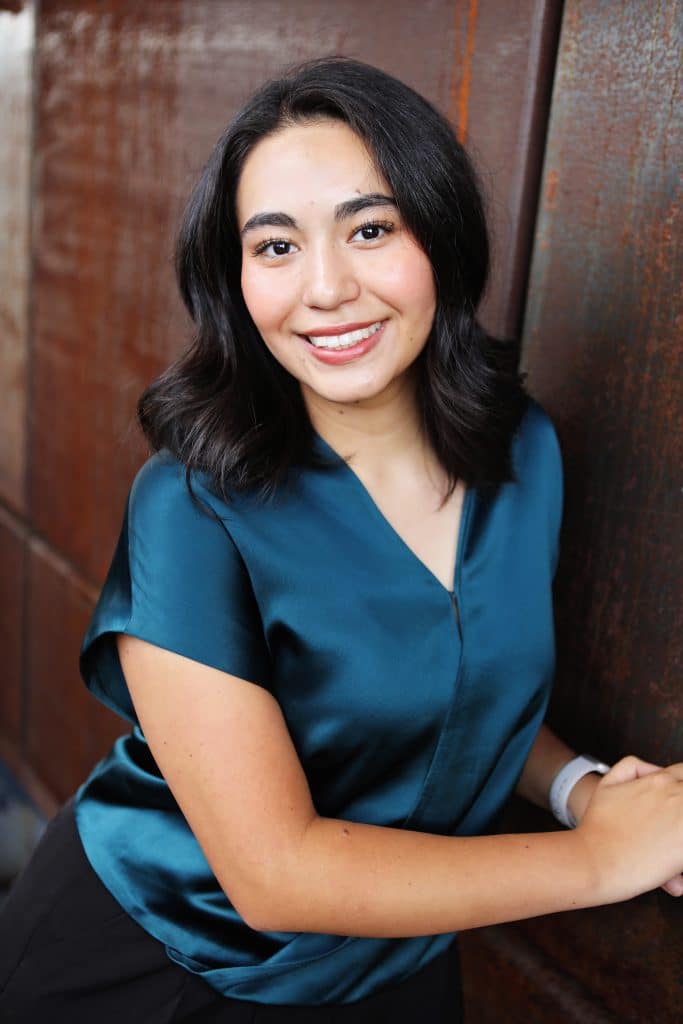
Music Student at Peabody Institute
Johns Hopkins
Alia Uffenorde
Alia Uffenorde is a Seattle-born violinist and alumna of Key to Change who began her classical music studies at age eight. A passionate educator and performer, she served as Concertmaster of the Tahoma High School Chamber Orchestra and Tacoma Youth Symphony and taught violin and piano at Voice in the Valley for four years. Alia has participated in prestigious programs including Interlochen Arts Summer Festival, Sphinx Performance Academy, and the Eastern Festival of Music, where she received a full scholarship. She is currently pursuing a degree in Violin Performance at the Peabody Institute of Johns Hopkins University, studying with Herbert Greenberg, and performs as a chamber musician with the Sage Piano Trio. Through her dedication to music, education, and community, Alia continues to grow as both an accomplished musician and inspiring mentor.
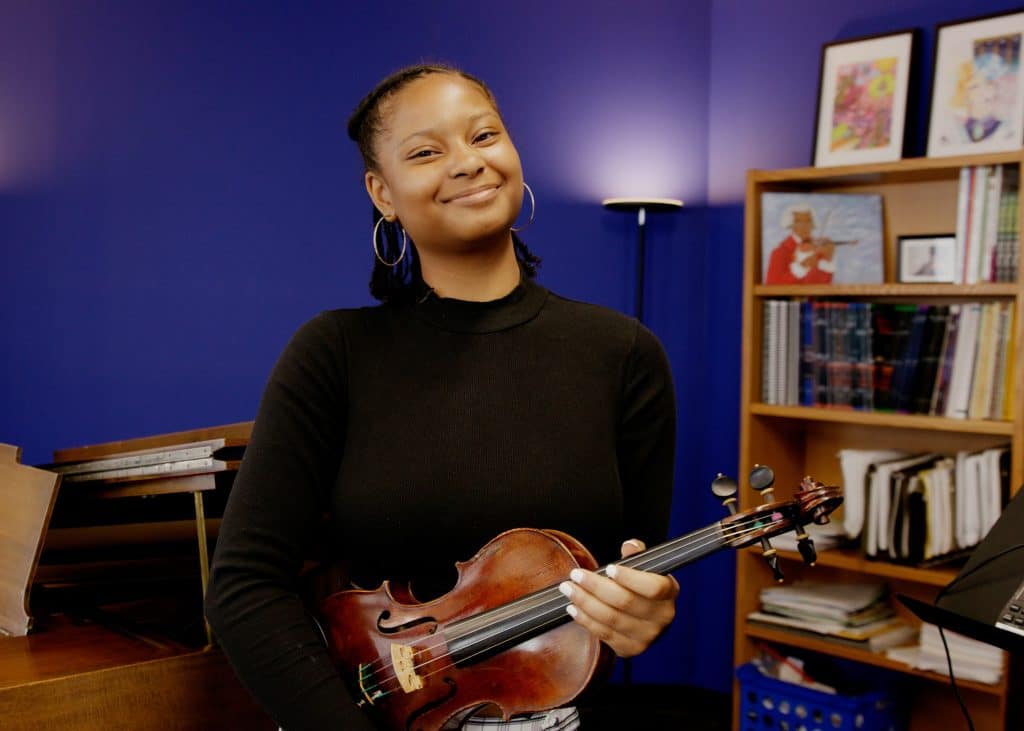
Collaborative Arts Student
New York University
Amani Tompkins
Amani Tompkins is an intelligent and inspiring creator whose artistic journey began with poetry and blossomed into a multifaceted expression of purpose. At 18, she has fully embraced her identity as a violinist, dancer, poet, singer, and performer—using each discipline to uplift, inspire, and advocate for others. As she graduates, Amani looks ahead to pursuing a BFA in Collaborative Arts at NYU’s Tisch School of the Arts. There, she hopes to continue exploring the intersections of multiple artistic disciplines. She aspires to use her skills to create a music therapy practice tailored to African Americans diagnosed with Alzheimer’s disease and dementia.
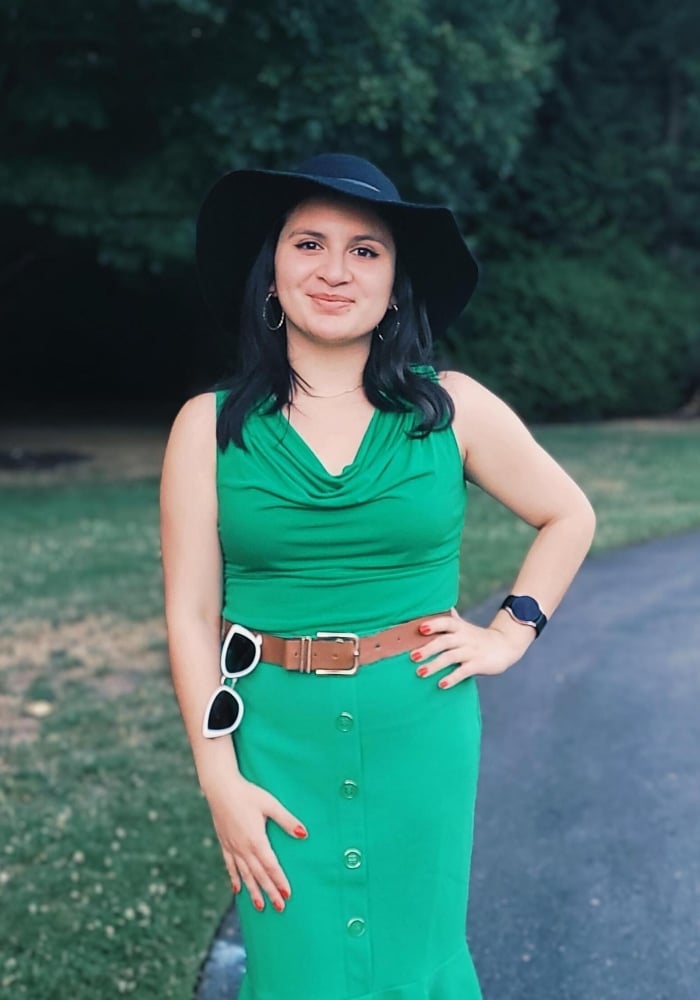
Visual Artist
Analisa Teresa Ruiz
Favorite piece of music right now: “Si Una Vez” by Selena Quintanilla
Analisa gained professional experience as a Key to Change Intern and Studio Assistant for several years, helping with student recruitment, administrative support, classroom assistance, teaching, community engagement, and more. She says music gives her serenity, focus, and a way to express herself. She remembers performing at Benaroya Hall with Key to Change during the pandemic, playing an exceptional violin donated to the Studio by luthier David Van Zandt: “It was an empty concert hall, and despite feeling so small on that grand stage, the sound of my violin filled the space. Words cannot describe how amazing and emotional I felt standing there on a stage that so many musicians have performed on.”
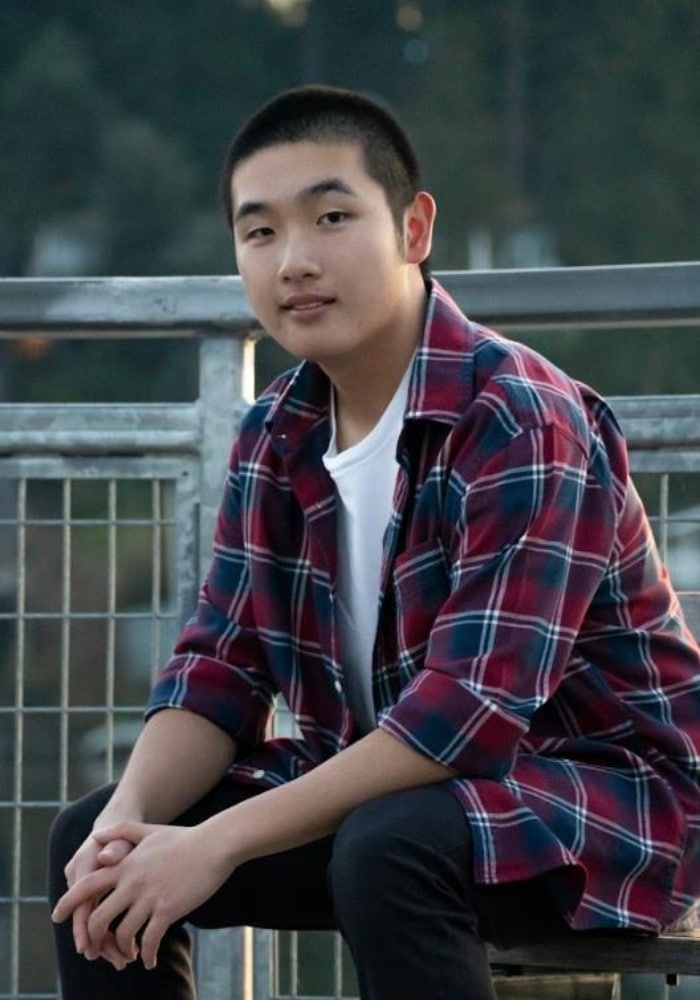
Computer science student
Seattle University
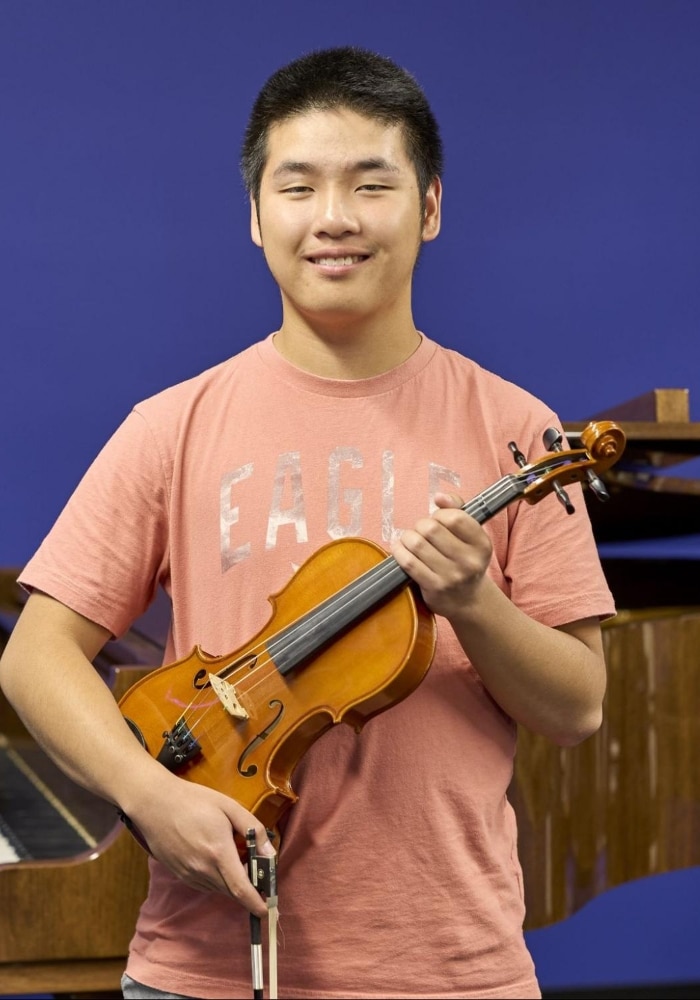
Derek Nguyen
Favorite piece of music right now:
“Les Toreadors” by Georges Bizet, which appears in the Five Nights at Freddy’s game series
and is the podium music after every Formula One race.
“Right now, music is a hobby and safe space for me to relax and escape the stress of the world,” Derek says. Looking back on his time with Key to Change, he remembers having fun with his friends in the Saint Georges group class, especially during Solo String Festivals. He credits the Studio with helping him develop his work ethic and become a stronger leader, team player, and friend. “Learning the violin and working together to play ensemble pieces has transformed me and made both school and work a LOT easier for me,” he says.
Mechanical engineering student
Seattle University
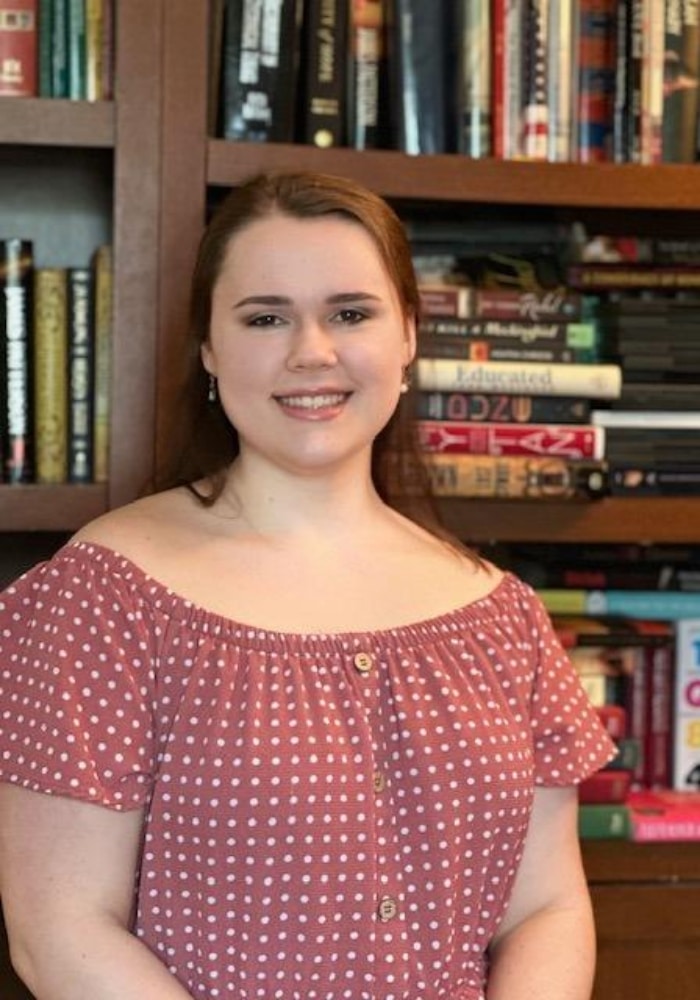
Devin Nguyen
Favorite piece of music right now:
The Japanese military march “Yuki no Shingun” and the
Finnish folk song “Säkkijärven Polkka,” both of which
were featured in one of Devin’s favorite TV shows.
When Devin first arrived at Key to Change, “I had no idea how to learn things,” he says. “Learning the violin was a great way to figure out how to improve at something.” After taking some summer classes at Bellevue College, he’s now enrolled at Seattle University, where he’s majoring in mechanical engineering. Devin still practices his violin and stays in touch with friends he made at the Studio. “Key to Change has played a big part in developing my social skills,” he says.
Nurse
Ellie Whitby
Favorite piece of music right now: Symphony No. 3 in A minor by Felix Mendelssohn (performed by the London Symphony Orchestra, conducted by Peter Maag), “Dance the Night Away” by Dua Lipa
After graduating from high school in the top 5% of her class, Ellie got a job with the medical surgery team at Valley Medical Center, where she continues to work while pursuing her nursing degree. Music still plays a huge role in her life, she says, in both her personal and professional life. “We often use music therapy at work as we find that it can help to calm patients.” Ellie still plays her violin and cherishes the “camaraderie and friendships” that defined her time with Key to Change. “It was such a supportive environment and the community vibes were amazing.”

Pharmacy Doctoral Student
University of Washington
Jolene Nguyen
Favorite piece of music right now:
Phantom of the Opera by Andrew Lloyd Webber
“Learning an instrument has taught me that I am much more capable than I think I am,” she says. Music continues to play an important, therapeutic role in her life, helping her to decompress. Reflecting on her time with Key to Change, Jolene says she most remembers the supportive community and friends she made through the program.
Music education student
Louisiana State University
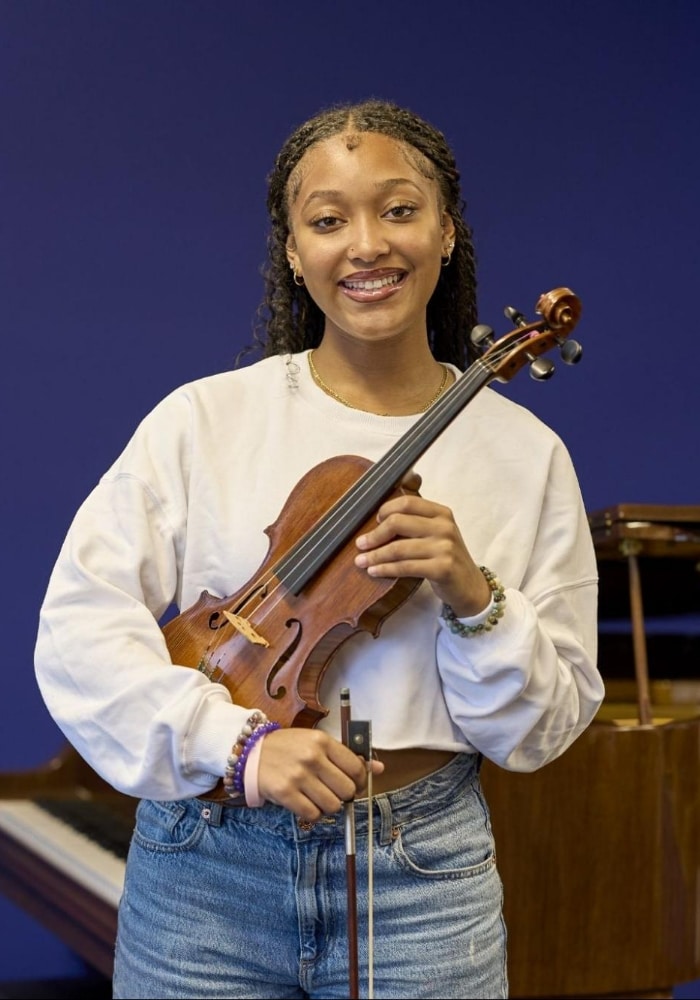
Madison Cole
Favorite piece of music right now:
“Adoration” by Florence Price
Madison discovered her love of music at Key to Change. It also helped her grow both her self-confidence and her work ethic. “My instrument taught me that initial talent isn’t what gets you far,” she says. “It’s how hard you put in work behind the scenes that matters.” Madison found her best friend at the Studio, too; they got closer by supporting each other during concerts and classes.
Physical therapy & Spanish student
Central Washington University
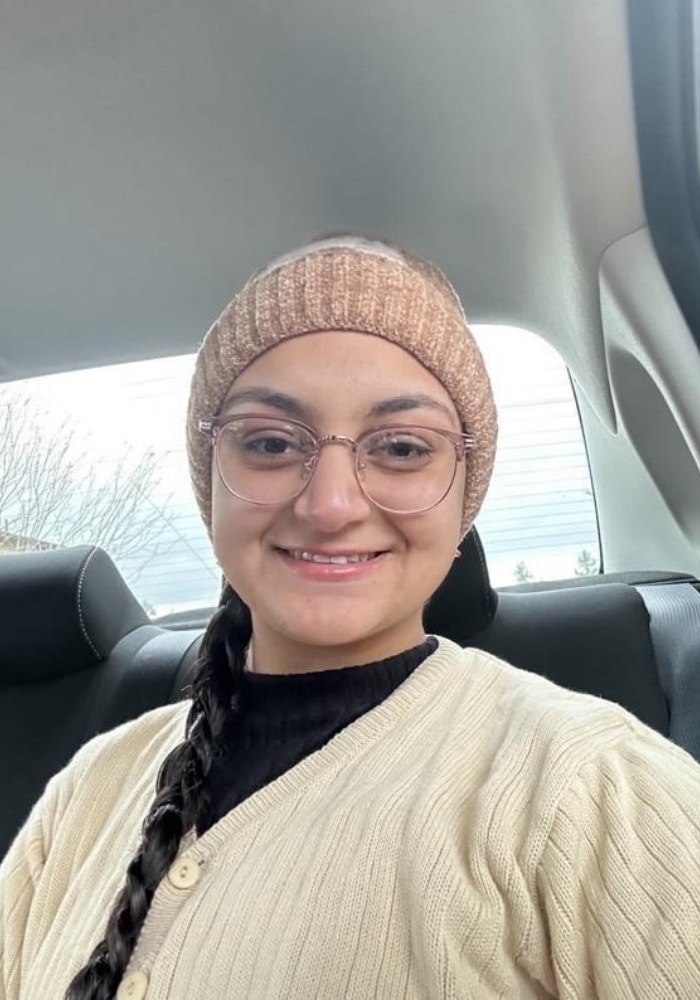
Malak Ali
Favorite piece of music right now:
The Sanctus movement of Johann Sebastian Bach’s Mass in B minor.
As Malak gets started at Central Washington University, music continues to drive her productivity. “Playing music and learning music gives me purpose,” she says. Looking back on her time with Key to Change, she still remembers every concert, every class, and hanging out with the great friends she made through the Studio. Her time with the Studio taught her that she is a “powerfully resilient person,” she says. “Learning an instrument helps catalyze the trial-and-error cycle. I am not afraid to try and fail, then dust my knees off and keep trudging no matter what.”

Implementation Consultant
Fast Enterprises
Richie Doan
Favorite piece of music right now: “Hummingbird” by James Blake and Metro Boomin (from the Spider-Man: Across the Spider-Verse soundtrack)
“Music has always been a way for me to explore and express my emotions,” Richie says, explaining how studying the violin helped him articulate his feelings and practice empathy. Key to Change taught him “the value and importance of making mistakes,” he says. “Being surrounded with so many brilliant peers and educators is humbling and puts you in an extremely special place where you can grow in earnest without fear of being excluded or demeaned. You develop a really healthy relationship with criticism and failure, which I still find to be invaluable.” Richie studied Computer Science & International Studies at the University of Washington and now works for a software development company on the East Coast.

Aerospace engineering student
Seattle Central College
Zora Rose Mtunga
Favorite piece of music right now:
De Taeye’s “Humoresque” and “The First Taste” by Fiona Apple.
In addition to being an engineering student, Zora is also working in customer service at Northwestern Mutual, where she’s become interested in financial technology. Once she completes her two-year degree at Seattle Central, she plans to transfer into the University of Washington’s Informatics program. She says her experience with Key to Change has been “profoundly influential” because it motivated her “to overcome obstacles and approach every room with confidence, even in fields like classical arts where diversity can be limited.”

Doctoral Violin Student
at Peabody Institute
at Johns Hopkins University
Hayley Camp
Favorite piece of music right now:
Phantom of the Opera by Andrew Lloyd Webber
Hayley Camp is a violinist, educator, and Key to Change alumna whose career reflects a commitment to artistic excellence, education, and expanding access to classical music.
Hayley studied violin with Dr. Quinton Morris from 2017 to 2018. During her time at Key to Change, she prepared for and successfully auditioned for the Peabody Conservatory of Music at Johns Hopkins University. She went on to earn a Bachelor of Music in Violin Performance from Peabody, where she studied with Herbert Greenberg, as well as a Bachelor of Science in Applied Mathematics and Statistics from Johns Hopkins University.
Following her undergraduate studies, Hayley continued her musical training at the Cleveland Institute of Music, studying with internationally acclaimed violinists Jaime Laredo, Jessica Lee, and Malcolm Lowe. She has since returned to the Peabody Conservatory, where she is pursuing a Doctor of Musical Arts in Violin Performance on a full scholarship.
Originally from Des Moines, WA Hayley has developed a multifaceted career as a performer, educator, and advocate for greater accessibility in classical music. She has performed with ensembles including the Firelands Symphony Orchestra, Cleveland Pops, Bach in Baltimore, Canton Symphony Orchestra, and Akron Symphony Orchestra, appearing in distinguished venues such as Benaroya Hall, the Kennedy Center, and Severance Hall. Her work as a multi-genre artist has also included collaborations with art museums, fashion shows, independent films, jazz ensembles, video games, and musical theater productions.
Education and community engagement are central to Hayley’s work. She has taught and coached young musicians through organizations including BSOrchKids in Baltimore, the Baltimore and Tacoma Youth Symphonies, Evergreen Music Festival, and the Tri C Orchestra Program in Cleveland, which provides no cost music education to young people. Her commitment to community based music making has also included performances at women’s shelters, public concerts, and programs designed to strengthen connections between conservatories and the communities they serve.
Hayley’s journey from Key to Change to some of the nation’s leading music institutions demonstrates what sustained mentorship, opportunity, and rigorous musical training can make possible for a young artist.

Theater Student
Central Washington University
Amariah Strand
Favorite piece: Niccolo Paganini Caprices no. 1 and 12.
When Amariah Strand came to Key to Change, she learned that progress requires more than talent or simply being in the room. “Some days you see progress, and other days you don’t,” she reflects. Learning the violin challenged, surprised, and sometimes frustrated her, but it also taught her to build better habits, manage her time, stay organized, and keep showing up when she wanted to improve.
As a Black student studying with a Black instructor, Amariah also came to understand the power of representation. “I was already challenging a stereotype simply by being there,” she says. At the Studio, she saw students of different races, genders, and backgrounds coming together through music, expanding her idea of what a violinist could look like. “Representation isn’t just about seeing someone who looks like you,” she says. For Amariah, it became about seeing possibility, belonging, and the many different ways a person can grow.

Madison Wooley
Favorite piece: Niccolo Paganini Caprices no. 1 and 12.
For Madison Wooley, learning the violin at Key to Change was also an exercise in learning how to trust herself. Each practice session asked her to focus, listen closely, work through frustration, and try again. Little by little, that persistence became more than a way to improve as a musician. It became part of how she approached school, work, and everyday challenges. “The violin taught me self-discipline,” she reflects. “You have to stay committed and keep going, even when something is difficult.”
But some of Madison’s most meaningful growth came when she stopped trying to get everything exactly right. At Key to Change, she learned to give herself permission to make mistakes, take chances, and enjoy the process. “You have to get out of your head and into the music,” she says. That lesson helped Madison build confidence in her own voice while developing the communication, collaboration, focus, and perseverance she carries with her today. For Madison, becoming a stronger violinist also meant becoming more comfortable simply being herself.